
Three Worlds, One Creator

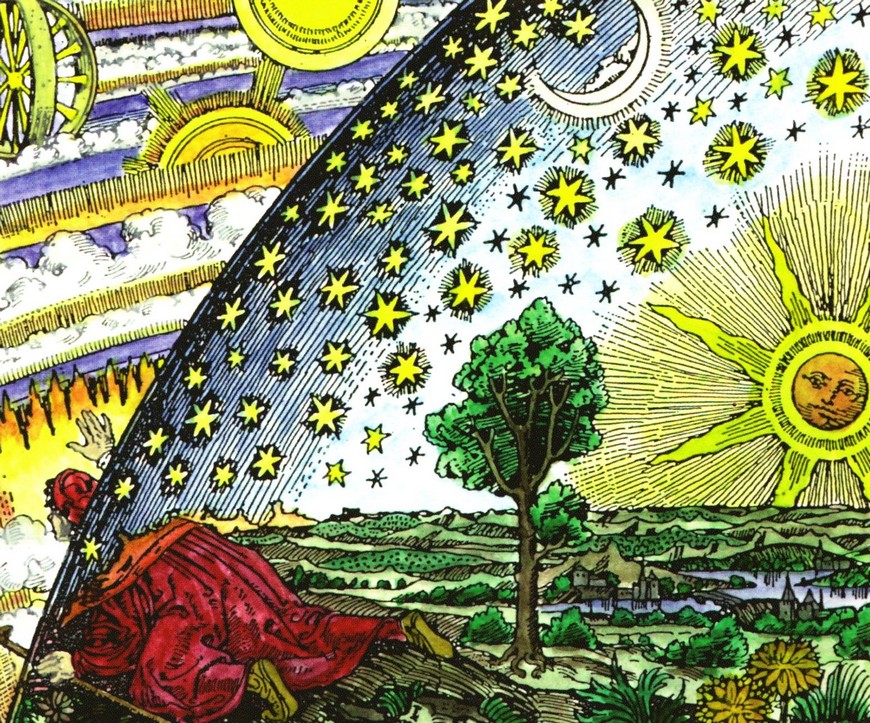
What is meant when someone says “the cosmos”? Usually, they are referring to the Universe. However, in essence, it is not the Universe as understood by modern humans. When these concepts began to be equated, it was perceived differently. The cosmos was once thought of as the created world: a flat earthly expanse, covered from above — like a dome — by the firmament of the heavens, with everything that existed between them. The Creator of the cosmos himself remained outside of it, as if standing above his creation. Many are familiar with the famous old illustration depicting a man who reached the edge of the cosmos and poked his head beyond its bounds, into a realm marked by symbols of Divine presence. Such an image of the cosmos no longer relates to modern conceptions of the Universe. The term has either lost its original meaning or has expanded it immensely, extending to encompass the entire cosmos — as it is now understood. It seems there is no single, current definition for the term “cosmos”; and if it continues to be perceived as a synonym for “Universe”, it is merely out of inertia, despite the fact that our understanding of the Universe itself has changed.
The Teaching gives the concept of “cosmos” a different meaning, broader than “Universe”. Although in a narrower sense — Earth, the sublunary world, so to speak — it is also sometimes used. In the former case, “Cosmos” is written with a capital letter, in the latter — with a lowercase one.
When the Creator transformed himself into the Universe, he first transformed his substance into another substance — into what we call Spirit. Then part of the Spirit condensed, became denser, and transformed into energy. Perhaps this was what is commonly called the Big Bang. Specialists generally agree that it was an outburst of energy — an outburst of monstrous, unimaginable force and intensity. All matter later formed from this energy. But where did the energy come from, and in such a quantity that it was sufficient, as building material, for an entire Universe? Specialists shrug. It seemed to appear out of nowhere. It just came into existence. Yet this sounds unserious and unconvincing. Nothing comes from nothing. According to the Teaching, energy is condensed Spirit. That is, before the Big Bang, there existed a colossal volume of Spirit substance, the condensation of which caused the explosion and outburst of energy. It is simply that there are no current means to detect the substance of Spirit. Its properties lie beyond the sensitivity range of modern instruments. Therefore, it seems that nothing existed before the Big Bang. However, the views of science and the Teaching coincide regarding subsequent developments: energy began transforming into matter.
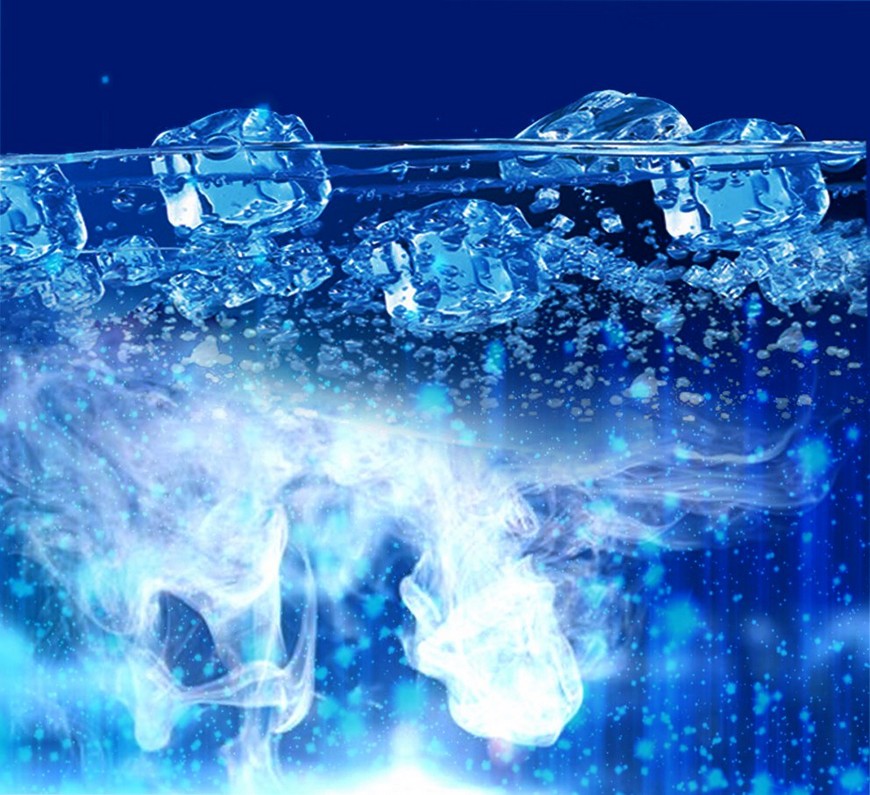
This can be compared to the three states of water, where steam is Spirit, the condensed liquid is energy, and solid ice is matter. Indeed, it is a good illustration of the process. But only as an illustration. Because water cannot simultaneously occupy the same space in all three states, whereas Spirit, energy, and matter can. There are three worlds: the world of Spirit, the world of energy, and the world of matter. Each exists at its own level of density and quality of substance. They are embedded within each other: in every particle of matter, there is a particle of energy, within which, in turn, there is a particle of Spirit.
This combination of three worlds (which some might call “planes”) is what the Teaching refers to as the Cosmos. The meanings of “Cosmos” and “Universe” are thus distinguished and cease to be synonyms. If the Cosmos is the three worlds together, their unified system, then the Universe is only the world of matter, the physical outer space where material bodies can move.
The combination of the three worlds — the Cosmos — is the Creator Himself. However, for simplicity and clarity, we often say that the Creator is the Universe, that he transformed himself into the Universe, though, of course, meaning the Cosmos. Thus, in this sense, we almost turn them back into synonyms, though conditionally and for clarity, as stated. It is much simpler (especially for those just beginning to study the Teaching) to imagine the Creator as the Universe that we can see and touch, rather than as a system of three planes, two of which remain invisible. So, the world of matter, the physical world, is the material body of the Creator. The world of Spirit is what can be called his soul. The Spirit carries the qualities of the Creator — both the original ones carried over from the state before the transformation into the Universe and the newer, more perfected ones developed after the transformation. In essence, the world of Spirit contains the personality of the Creator. The Spirit also serves as a conduit of the Great Principles, which serve as the source and foundation for all laws operating in the Cosmos and drive its evolution. The world of energy, positioned between the other two, connects them. In it, the laws derived from the Great Principles acquire energetic bodies and become what the Teaching calls higher elementals, or gods. These laws govern the world of matter. The Teaching calls the lower elementals — those energetic bodies of material beings, objects, and phenomena — elements composed of energy. One could say that the world of matter is constantly nourished by the world of energy, like an enormous battery with an almost inexhaustible resource, and thus can exist and function. The Great Principles, through the Spirit, are transformed into laws that, in the world of energy, acquire energetic flesh and, from there, drive evolution in the world of matter. It gives rise to sentient beings — intelligent species capable of refining the Spirit, improving its qualities. These are the interconnections of the three worlds of the Cosmos, though described only in broad terms. The Cosmos is a unified system in which each level fulfills its function, necessary for the other two. All for a common purpose. All so that the Creator can ascend to a new stage of evolution and undergo transformation into a more perfect being. That is why he transformed himself into the Universe (that is, as the Cosmos).
Perhaps all this sounds somewhat heavy. But the essence is simple: the Cosmos, this unified system of three worlds, is a living being, our Creator. The three worlds are his soul, energy, and flesh. He lives and develops thanks to their interaction. And the most paradoxical thing is that we don’t need any instruments to confirm this. Because we are structured the same way. Within a person, who is a part of the Creator, there are the same three levels: Spirit, energy, and matter. So, all this is not abstract to us but profoundly concrete. Look at yourself — and you will see the Cosmos in miniature. In its “three-layered” structure, a person resembles the Creator. Though not only in this. But that is a topic for another conversation.
© Atarkhat, 2017