
Above and Below

In the text of the famous Emerald Tablet, attributed to Hermes Trismegistus, a fundamental (as many believe) principle of Hermeticism is formulated: as above, so below. However, this idea can be found not only in Hermeticism but also in some other teachings. Everywhere it is interpreted roughly the same: as a statement of the fact that the Microcosm is similar to the Macrocosm — that is, a person is similar to the Universe (in some interpretations, to God). Similar in structure, in the principles of existence. Essentially, it is an indication of their unity, in a certain sense even of their identity. Yet when it comes to substantiating this postulate, to pointing out in what exactly they are similar, it usually turns out that there are no clear answers. Or rather, there are, but almost all of them are interpretations of various obscure texts, drawing profound and vague maxims and hints from them. In other words, it is not so much about what is there as about what someone wishes to see there.
So, is there real meaning in this statement? Are the Microcosm and Macrocosm truly similar?
Yes, they are. A person and the Universe are similar in a whole range of important aspects. Although it would be more correct to say — a person and the Creator (a fundamentally important correction, considering that the material Universe is only the physical body of the Creator). They are not only similar but identical. But let us consider everything in order.
First of all, the Creator, like a person, came into being as a result of evolution. This evolution took place (though why say “took place”? It continues even now) in another Universe, immeasurably greater than ours; and its timescales were also immeasurably longer. Its result also surpasses all possibilities of our imagination: the mere fact that the Creator was able to transform his own organism, establishing in it the laws by which it functions and setting the direction of evolution, is difficult even to imagine. But that is not the main thing. The main thing is that he is not a supernatural being but participates in evolution, just like a person. In fact, we and the Creator participate in the same evolutionary process. Our evolution is part of the Creator’s evolution. And this is not just similarity but identity.
Like us, he comprehends his world and himself to become more perfect. This principle of development — through knowledge — is the same for us and for him. It is unknown how exactly he comprehended his world, through what sensory organs, by what methods. But for him, as for us, knowledge is connected with perception, observation, thinking, analysis. We inherited all this from him because our mind is his mind, operating by the same principles but, so to speak, on a smaller scale. And our cognition itself is the Creator’s self-cognition. Having dispersed his mind among countless hosts of sentient beings, humans and non-humans, he observes himself through their eyes, studies himself through their minds, draws conclusions about himself through their thinking. And this is again identity.
The general scheme of human development looks like this: a person comprehends the structure of the world and they place in it, gains the ability to understand what is good and what is evil, learns to distinguish them and make the right choice between them, thereby improving morally. Thus the Spirit is perfected — the soul of the Creator, as well as his mind, dispersed in countless living beings. Including in humans. This means that when a person becomes better and more perfect, the Creator also becomes better and more perfect. We share the same goals: to become better through knowledge and moral choice. What he achieved before his transformation into the Universe (though it would be more accurate to say — into the Cosmos) belongs to us, is contained within us; what we achieve becomes his achievement. And so we come again to identity.
In general, identity can be noted in many different aspects. Our evolution is his evolution. Our minds and our knowledge are his mind and his knowledge. Our qualities and our moral development are his qualities and his moral development. Our souls are his soul. Our flesh is his flesh. He looks at the world — that is, at himself — through our eyes; we see him by looking in the mirror. If he perishes, failing to achieve what he must, we too will perish — though we will then already be in the realm of the Spirit. But if he succeeds, becomes more perfect, and continues his path, we will continue with him, as his particles. And so on, and so on.
The list of similarities that turn out to be identities can be continued. But the essence boils down to a simple fact: we and the Creator are one whole. I said “a simple fact” — but it is simple only as a fact in itself; it is not at all simple to grasp in the mind. And to understand how all this is arranged and how it works is even more difficult, immeasurably more difficult. In fact, we exist precisely to understand this. This understanding is the goal of science and philosophy, the goal of knowledge in general.
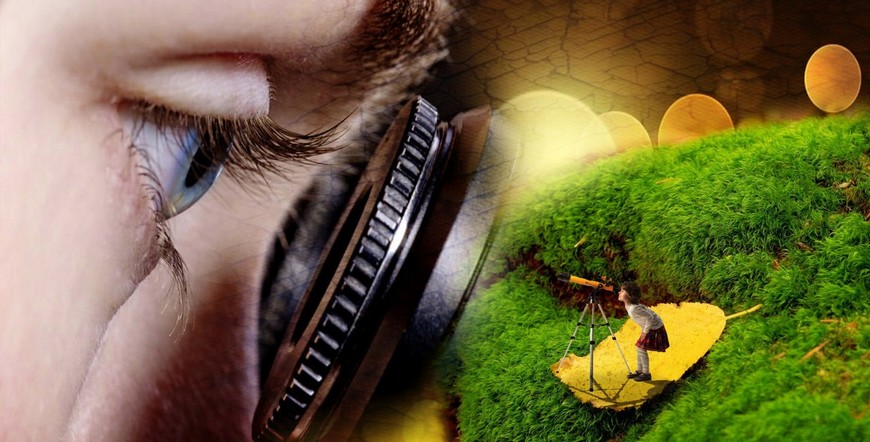
We comprehend the world — and thus comprehend ourselves, because we begin to see our place in it more clearly, begin to better understand our purpose. We comprehend ourselves — and thus comprehend the world, because we are its particles. Long ago, the principle “Know thyself” was proclaimed. And that is exactly what the Creator is doing now. We comprehend ourselves — he comprehends himself. It is interdependent. He turned his gaze inward; we, peering into the vastness of the Universe, look at him — and thereby look at ourselves. That is, a person studies himself both by looking through a microscope and by looking through a telescope. It is astonishing and grand. And the result? When we become wiser and better, the Creator becomes wiser and better. In a certain sense, we are engaged in construction: we are building the Creator from within, constructing him, new and better. Through evolution, he created us — and now we, living one life with him, create him.
Sometimes I am asked: could it be that within us, on a microscopic level, there live some beings — not bacteria or microbes, but sentient beings — who are to us what we are to the Creator? I can answer this way. Exactly the same — not likely. After all, a person does not create a Universe from himself and does not direct his internal evolution as the Creator directed his — therefore, the mechanics of his internal development work differently. But it is possible that in some particles of our organism — like atoms — there are some kinds of Universes. Why not? If scale can unimaginably increase in one direction — atom, person, Creator, Creator’s Universe, and further, to the infinity of Being — then it can unimaginably decrease in the other direction. Person, atom, Universe within an atom, someone living and sentient in that Universe, and further… This is indeed possible, and even logical. And so, when we speak of “above and below”, we are not necessarily speaking only of the Creator and the person. Perhaps we are also speaking of the person and… And of what? Of the Universes hidden within us and their inhabitants? Well: perhaps we will find out someday.
© Atarkhat, 2017