
Not to Be Confused with God!

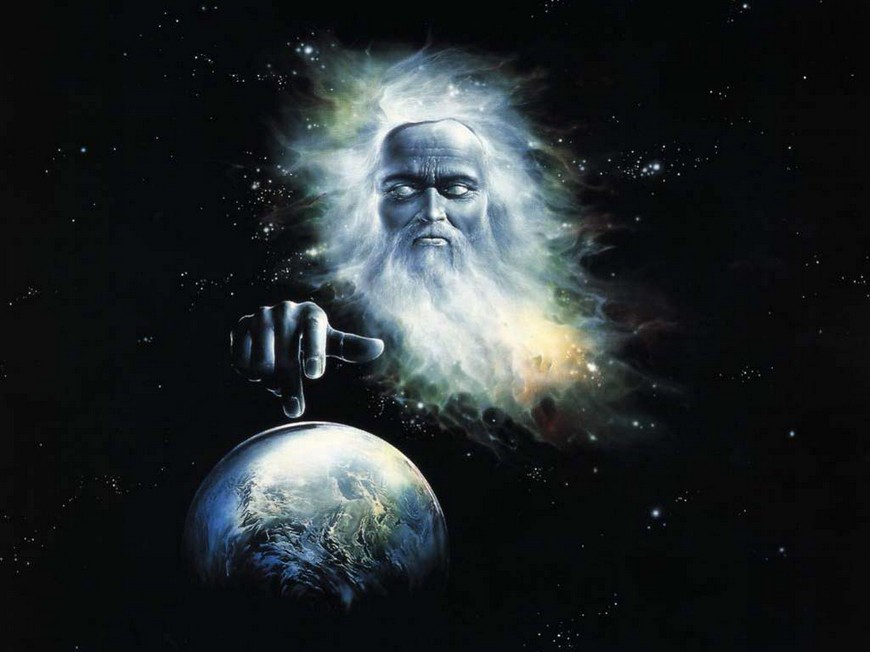
The Teaching of the United Temple (TUT) is not a religious teaching, yet it speaks of the Creator. And it doesn’t just mention the Creator — it teaches that everything for a person originates from the Creator as the cause and returns to him as the ultimate goal. Humans exist because they are needed by him, and the purpose of their lives is to perfect him. Our flesh is his flesh, our mind is his mind, our best qualities are his qualities, and our souls are fragments of his soul. We dwell within him, for the Universe is him. Everything, in one way or another, is tied to the Creator. Yet, we do not identify him with the omnipotent God of monotheistic religions, nor do we attribute to him the corresponding divine attributes.
But how is that possible? How can he be everything described above and yet not be God? Doesn’t this require truly divine qualities? No, not necessarily. The problem lies in the human tendency towards stereotypical thinking. When people hear about someone who created the Universe, established its laws, and is the source of everything we have, they instantly say, “That is God!” — meaning the eternal, omnipotent, perfect, and unknowable Lord. But in this case, they are mistaken. The Teaching speaks of someone else entirely.
This distinction can be confusing and even disorienting. Indeed, those who accept the Teaching as their spiritual path must adapt to a new perception of the Creator. Whether they were previously believers or non-believers, everyone has a similar association with the word “Creator.” But unless this perception changes, unless one learns to see the Creator differently, it will be impossible to correctly understand the Teaching. This is crucial for both those who have already chosen the Teaching as their path and those who are just beginning to explore it. Therefore, it is important to specifically highlight the differences between the God of monotheistic religions and the Creator as described in the Teaching.
The following are lists of the essential attributes of God—that is, the supernatural qualities he possesses as God, which serve as evidence of his divinity to humans. Below, I will list several of these qualities in terms of what the Creator does not have and explain why these cannot be attributed to the Creator. This will clarify why the Creator and God are not the same and why they should not be confused.
So, the Creator
Not unique in kind. Unlike God, who is unique and singular, the Creator is one among many of his kind. He belongs to a sentient species that exists in his world — a whole people of Creators. Each of them undergoes a phase of self-awareness and inner development, just as our Creator does. This implies that there are other Universes besides our own.
Not perfect. He came into existence as a result of evolution — that is, the natural development of the Nature of his world. This evolution continues, and the Creator, as part of it, also continues to develop. This is necessary for him in order to live. It is precisely for the sake of continuing his development and his life that he transformed himself into the Universe. In other words, both the Universe itself and everything within it, including humans, exist because the Creator is imperfect. We owe our existence to his imperfection. It gives us life. After all, a perfect being needs nothing and strives for nothing — it is already perfect and possesses everything it requires. If the Creator were perfect, he would have no reason to create the Universe.
Not immutable. Only a perfect being can be immutable. It is unchanging precisely because it already contains everything possible and has nowhere further to move or develop. When change occurs, it is always a transformation of something into something else — either towards improvement or towards degradation. However, a perfect being cannot degrade, as it has no flaws or prerequisites for degradation, nor can it become more perfect, for it is already perfect. In other words, it simply has no room for change. The Creator, however, is imperfect; he has room to move and grow. He must change in order to continue living — and he does change.
Not eternal. The Creator is a representative of an intelligent species that emerged through the process of evolution. This species itself had a beginning — it once appeared as a result of evolutionary changes. This alone is enough to understand that the Creator is not eternal. There was a time when his species did not exist, and a time when he himself, as an individual, did not exist. The Creator was once born — although we do not know (or do not yet know) how this happened. And one day, he will die, ending his life journey. How this will occur is also unknown. Perhaps it will be a form of merging with other Creators into a unified individuality, similar to what will happen with humans and other sentient beings in the world of Spirit. One can only say with certainty that there was a time when he did not exist, and there will be a time when he no longer exists. At the same time, the end of the Universe will mark the end of the Creator’s life only in the worst (and least likely) scenario. In the best-case scenario, he will continue to exist in a more perfected form.
Not infinite. In his world, the Creator is an individual entity, a separate organism. His organism is the Universe, and it has boundaries. That is, it possesses a kind of shell — something that separates it from an even greater Universe, of which it is a part. It is somewhat like how the peel of a fruit separates the fruit itself, its inner part, from the surrounding world. Boundlessness and eternity are interconnected qualities; if one is absent, the existence of the other is not ensured. The Creator is neither boundless nor eternal. Only Being possesses both of these qualities.
Not omnipotent. The Creator is a product of evolution and far from perfect. His abilities and capabilities are determined by the level of his evolutionary development. He accomplished something that is difficult for us to even imagine: he subjected his own organism to a complex transformation, creating the Universe from it. Within it, he established laws and initiated processes that enable it to live and develop. However, he was not entirely free in this. He could act only within the bounds of the laws of Nature of his world and the higher laws — the Great Principles. His creative and, so to speak, engineering abilities had limits. These limits remain even now. Currently, the Creator is constrained by the very laws he established in the Universe. He lives by them, submits to them, and cannot arbitrarily change them. Moreover, in his current state, he is unable to comprehend what is happening or to plan anything for the future.
Not omniscient. By “omniscience” one usually understands conscious all-knowingness with the ability to be aware of what one knows. For the Creator, at his current stage of development, this is inaccessible. At present, he does not perceive himself as a unified personality. His mind and conscious perception are scattered across countless sentient beings inhabiting the Universe. His perception and thinking are fragmented and mosaic-like. He knows what is known to the sentient beings — but for him, all this does not form a single, cohesive picture, and he cannot comprehend it with a unified consciousness. What is unknown to the sentient beings, he perceives at the level of sensations, but he also cannot comprehend it or be aware of it. As a result, he perceives everything that happens in the Universe in some way, but it cannot be said that he “knows” it in the sense understood when speaking of God. God knows everything, is aware of it, transforms his knowledge into actions according to his desires, and thus controls the entire world. The Creator, however, senses but does not comprehend everything as a whole, cannot conceptualise or control what is happening through his will. Therefore, this is not what is referred to as “divine omniscience.”
Not self-sufficient. The Creator is not perfect, and therefore, not self-sufficient. He evolves, and evolves as part of his world, dependent on the surrounding environment. Everything he has, he receives from the Nature of his world, over which he has no control. The laws that he “programmed” into the Universe, that is, into his own organism, are derived from the laws acting in his world. The Creator depends on what is greater than him. At the same time, he is also dependent on what is smaller than him. The speed and success of his development now depend on the sentient beings, through whom he learns about himself and improves. The final result will also depend on them. Thus, the Creator is not only not self-sufficient, but doubly dependent, dependent in both directions: towards what is larger than him, and towards what is smaller.
Does not predetermine the future nor does know it. As mentioned earlier, the future of the Universe — and thus the future of the Creator — depends on the sentient beings, on how successfully they will learn and improve. Their collective improvement is the Creator’s improvement. His will has become their free will. This means that their will is not simply an expression of the higher will of the Creator, forcing them to act in a certain way — in a way that is necessary for him. Their will is free, meaning they can act contrary to the Creator’s needs, make wrong choices, and harm him. Hence, there is uncertainty about the final outcome. The sentient beings are free in their choices, free in their actions, and if they falter, make too many wrong choices, then in the final moments of the Universe’s existence, the Creator will not transform into a more perfect being, but will perish. And he was aware of this possibility when he initiated the evolutionary process in the Universe. He did everything he could to make the favorable outcome more likely than the unfavorable one — but he did not and does not know how it will all turn out. After all, predestination would strip the sentient beings of their free will, making the Creator’s internal development impossible. In fact, for the chance to become more perfect, he pays the price of risking perishing.
Not unknowable. The particles of the Creator, which we call sentient beings, know him from within. Their knowledge is his self-knowledge. This is precisely what he transformed himself into the Universe for. Therefore, he must, by definition, be knowable to his particles. Through knowledge and free choice, they improve morally and spiritually, thus improving the Creator. Knowledge is both a process, without which one cannot move forward, and a tool that makes it possible to carry out another necessary process. If the Creator were unknowable to his particles, they could not be what they are meant to be. The entire evolution of the Universe is aimed at the emergence of those capable of knowing. They appear and are endowed (through evolution) with everything necessary to know the Truth, reality, and the Creator. Without these abilities, the existence of the Universe would have no meaning. It was initially “designed” by the Creator as something that must be known and understood.
These are the key fundamental differences between the Creator, as described by the Teaching, and God, as described by religions. I intentionally based my explanation on the religious approach and explained how the Creator differs from God, rather than the other way around. This is because it is the Creator who is often confused with God, not the other way around. One must start from the religious criteria and answer the question, “What in the Creator does not correspond to the attributes of God?” And since it turns out that there are no matches with the defining attributes, it immediately becomes clear to a person who has an understanding of them that the Creator is not the same as God. This is precisely what I wanted to demonstrate.
Of course, certain similarities can be found. But with such differences, differences in the most essential foundations, no similarities will be sufficient to equate the Creator with God. Moreover, even in the similarities themselves, there are very eloquent differences. For example, both are creators of the Universe. But their ways of creation differ greatly (supernatural and miraculous for God, natural and evolutionary for the Creator) as do their motivations (if, of course, anything definite can be said about God’s motivation at all).
To conclude, the Creator and God are not the same. And it is precisely because of this that our world exists, and we ourselves exist. Were the Creator perfect, did he not evolve, did he not need self-awareness, and was his future predetermined, there would be no us, humans, with our minds, our feelings, our qualities — both positive and not so positive, our creative abilities, and our free will. The imperfection of the Creator gave birth to us and allowed us to be who we are. It may seem that imperfection is bad. On one hand, yes. But on the other hand, imperfection is the possibility of improvement. And the possibility of improvement is life. In other words, imperfection is a blessing, if one does not reconcile with it. The Creator does not reconcile with his imperfection — and so we exist. And we will continue to exist as long as we do not reconcile with our own imperfection. And with us, he will exist. Not a distant, incomprehensible, and unknowable God, for whom nothing depends on us and to whose mood we are entirely and completely subject, but our Creator. The Creator, who is as close to us as is possible: for we and he are one whole, with a shared flesh, shared mind, shared soul. And shared fate. This is drastically different from the relationship between humans and God, isn’t it?
© Atarkhat, 2019