
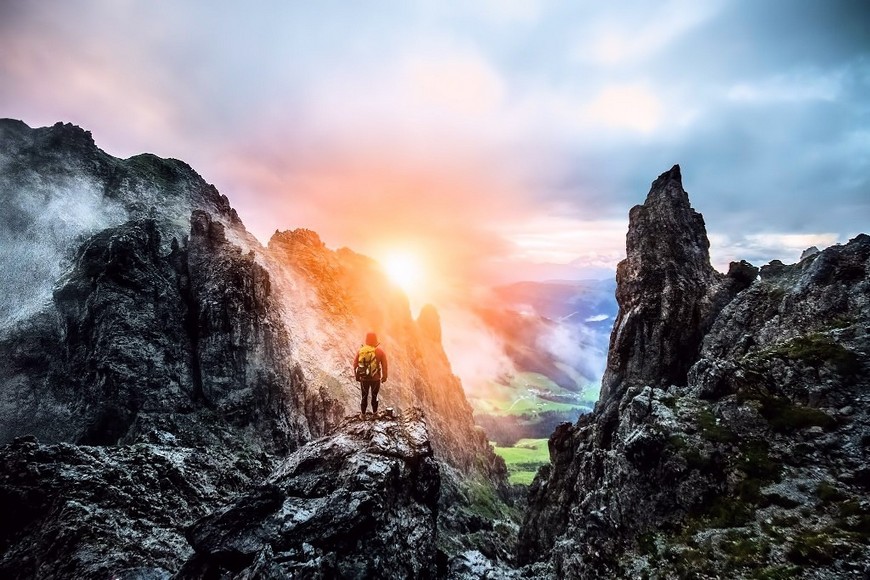
A Living Human in a Living World

It is customary to divide nature into living and non-living. The living includes people, animals, and plants, while the non-living is everything else. This division is based on the simplest principle: something is considered alive if it exhibits biological signs of life. The world of minerals, for example, as well as natural phenomena, does not fall under this definition. Although, at times, in science fiction films, we see attempts to depict fundamentally different forms of life — some kind of stone monsters or beings made of pure energy. The question of whether non-biological life is possible has also been raised for quite some time. It has been posed, yes — but it seems that no one knows how to answer it. Because no one knows what the signs of non-biological life might look like or how they should differ from biological signs. And many dismiss even the question itself as mere idle talk, being firmly convinced that non-biological life cannot exist.
It seems that the signs of life are being confused with life itself. After all, no one has yet clearly explained what life is in its very essence. Its presence is judged by a set of manifestations. And these are the manifestations that are characteristic of humans themselves. On the one hand, this is understandable: we see these manifestations in ourselves and know how to identify them. On the other hand, does that mean that whatever is unlike us is not alive? Apparently so. And such an attitude toward the surrounding world, toward its nature, is fraught with rampant predation on the part of humans. This is exactly what is happening. And even in relation to what is recognised as living. After all, it is still not very much like us, is it? Moreover, even toward one another, humans often behave in the same way. So what can be said about their attitude toward what they do not even recognise as living…
In reality, everything is alive. Absolutely everything. Being is permeated with the Life Principle. That is, Being itself is alive — it develops and perfects itself so that life does not cease. Accordingly, everything that exists in Being is alive. This includes the world of our Creator, the Creator himself — that is, our Universe — and everything that exists within it. Everything we see around us. The earth beneath our feet, stones and metal, mountains and rivers, wind and clouds, the sun and snow, a storm and an ocean wave. The living cannot exist within the non-living. And life does not emerge as a result of chemical reactions of inanimate matter. As a result of such reactions, matter — which is always living — only gives rise to other matter. In which we often refuse to see life.
And yet, in truth, humans have always been able to recognise life. From the very beginning of their history, they considered mountains, rocks, rivers, celestial bodies, and natural phenomena to be alive, believed that they had souls, tried to communicate with them, and even sought to build relationships with them. Today, this is regarded as the most primitive form of religion, primitive animism. Of course, humans are capable of turning anything into a subject of religion, from distant constellations to a hair in the nose. But that is merely the result of their interpretation of certain facts and phenomena. And if they have turned their understanding of the living particles of the living world into an element of their religion, that does not mean that these particles are not alive.
And not everything that appears to be religion is actually religion. Let’s take, for instance, the belief that everything around us is ensouled. It would indeed be purely a religious notion if it did not correspond to reality. Although the situation is even more intriguing: official materialistic science does not acknowledge the existence of a soul even in humans. And yet, there is also the division into animate and inanimate, reflected in languages and conventionally accepted even by science (animate objects and inanimate objects). But it turns out that, apparently, nothing is animated at all. Everything is merely objects, without a soul…
A subconscious knowledge that everything around us is animated and alive has always been inherent to humans on an instinctive level, even before the first religions emerged. They knew it, just as animals do — animals that do not separate themselves from nature and therefore perceive its vitality and ensouled nature as their own, and vice versa. This knowledge still exists within us today. Only it is suppressed by materialism — and the outlet through which it can manifest itself still lies in the realm of religion. A striking example of this is Shinto, which teaches that deities reside in everything that surrounds us.
Our journal has already discussed those whom the Teaching calls gods — higher elementals. These are energetic entities (which may also be called souls) of the laws of Nature, various global principles and phenomena, as well as large objects (such as planets). Meanwhile, lower elementals, according to the Teaching, are energetic entities (souls) of smaller objects and items. Essentially, they are what Shinto refers to as gods. Thus, those whom Shinto would call the deities of a mountain, a lake, or a tree, we would call the elementals of the mountain, the lake, and the tree. These are living beings that possess a certain degree of self-awareness — only they are not material but energetic. The Life Principle animates energy through the Spirit, and through energy, it animates matter. Elementals are present in everything around us; everything is alive and intelligent — although it is not the same intelligence that is inherent to humans. Everything has instincts — though in varying degrees and across a broad spectrum. If a stone, for instance, possesses only a basic instinct — the instinct of self-preservation — then animals have a much richer set of instincts. Some of them even display glimpses of instincts characteristic of humans — such as the instinct of knowledge.
Elementals exist in natural phenomena and objects, in both naturally occurring and man-made items, as well as in the bodies of living beings, which can also be regarded as objects. After all, the human body consists of the same matter, the same substances, as the surrounding world. It is in no way fundamentally different from the mountains, lakes, and trees mentioned earlier. But in addition to the elemental, which can be defined as a primal soul, it also contains what is called the human soul. This is the entity that contains the human personality and, after death, separates from the body and its elemental. Thus, within a person, as a part of the unified whole, two souls coexist: the elemental, which serves as the conduit of animal instincts, and the soul-personality. Their relationship is often quite complex, but that is a topic for another discussion.
It is crucial for humans to understand that they live in a living world, where everything is ensouled, everything feels, and everything observes them and their actions. Such an understanding changes everything. We must learn to love the world and everything that surrounds us. We are Nature’s children; we are its creations, and it loves us. And everything around us loves a person who perceives themselves as part of it. Yes, precisely so: a person, who prides themselves on their ability to love as a trait distinguishing them from animals, loves their world less than the world loves them. And they often do not even wish to acknowledge their world as living. But that is equivalent to psychological self-destruction — because if our world is not alive, then neither are we, its particles. So let us learn to see life. The world lives for us and through us. Let us, in turn, live for it, live within it, live through it. Let us live and love it. And then we will learn to see and understand how it loves us.
© Atarkhat, 2018