
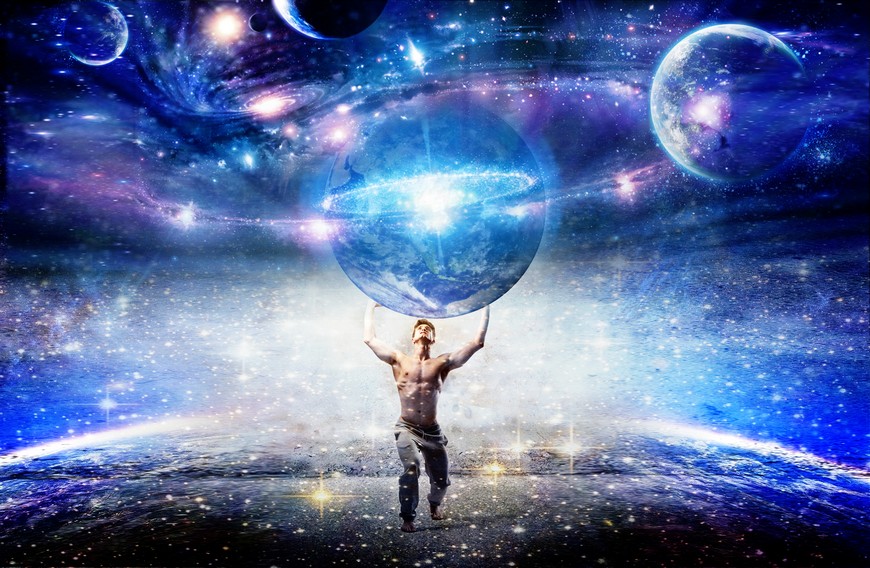
Atlanteans and Caryatids of the Universe

The caryatids stand — so proud and fair they seem,
With storms above them raging, with snowflakes in their gleam.
As once, back in my childhood, I envied all their might,
Their silent, solemn power, their ever steadfast height.Their torsos — carved perfection, one simply must admire,
Their muscles — firm and mighty, like stone they never tire.
And yet, their fate is easier: they never have to roam,
While we must bear our burdens and carry them alone.Through life we move — so fiercely, so tenderly at times,
With fate upon our shoulders and history in our minds.
The Titans, yes, are heroes, their strength beyond compare,
But people still surpass them — we struggle, yet we dare.R. Rozhdestvensky
In the existing books of the pandect today, the term “Great Duty” does not appear. However, much is said about what this term signifies, as it is one of the most important aspects of the Teaching — what pertains to human purpose. It was first called the Great Duty in the text “From the Heart” — a very important text, though not included in the pandect. But what is it?
Everything that exists occupies its place in Nature. Every particle of the Universe exists for a purpose, plays its role, and fulfills its task. This also applies to the sentient beings. They play a key role in evolution: through them, the Creator comes to know himself and perfects himself. The entire evolution of life forms — on Earth and throughout the Universe — is aimed at bringing forth beings in whom reason can awaken. Evolution is taking place on countless planets for the purpose of allowing fragments of Spirit to become sentient beings who are aware of themselves and the surrounding world, who can understand themselves and the world, discern good from evil, learn to make the right choice between them, become better, more perfect, and, in doing so, make the Creator more perfect. This is why he once transformed himself into the Universe. It was what he could and had to do. And now, the future — including the life of the Creator himself — is in the hands of the sentient races of the Universe, in the hands of the sentient beings. They can and must bring evolution — now more the evolution of Spirit than of matter — to its necessary culmination, making the Creator more perfect and capable of undergoing a new transformation. This is what we call the Great Duty. In reality, this is a concept of a universal scale. It concerns all sentient races without exception — those that have been, that exist now, and that will ever exist. It unites them with a common purpose. Every sentient being born in the Universe is born with the Great Duty.
At first glance, this might sound somewhat abstract: “every sentient being in the Universe”… Some being somewhere in the Universe… No. Not some being somewhere, but a very specific one. For example, you — here and now. And I. Every human being. Humanity, as one of the sentient races, has been assigned its share of the Great Duty. And each of us has received a part of it. It is embedded in us from birth, on a level deeper than the subconscious or genetics. On the level of Spirit. That very fragment of the Creator’s soul, carrying his best qualities and his reason, which, upon its first birth into a physical body, becomes the human soul.
Each of us (speaking here about humanity) inherently, simply by virtue of being born human — a sentient being — has a purpose, a kind of ultimate task called the Great Duty. This means that there is a profound foundation in life, a kind of axis, a core around which everything else is built — or at least, should be built. This is also psychologically necessary. Throughout history, people have asked, “What is the meaning of human existence, what is our role in the world?” Of course, one could simply live — eat, sleep, reproduce. Like animals. But a human is not an animal (regardless of what cynics and misanthropes embittered at the human race might say). This means that humanity is capable of something greater. But what exactly? The pursuit of power, the chase for fame, wealth, and pleasure? In other words, everything that cultivates vice in people and generates lies, violence, and suffering? But what is the point of that? Is it really worth being born human for that? Why does our world even need a being that destroys both itself and its surroundings? On the other hand, humans possess sharp intellect, deep emotions, remarkable spiritual qualities, and creative abilities. Were all these given to us merely so we could live an animalistic existence? This does not align with indulging in vice and the pursuit of selfish pleasures — rather, it contradicts them. Thus, there must be something greater. Something greater and good — the very reason we are born human. But what exactly? This question echoes as one of the leitmotifs in history, culture, and science. Or rather, not in science as such, but in knowledge-seeking. Humans have always sought to understand the world and their place in it. Whether that knowledge is scientific, philosophical, theological, mystical — even in the form of superstition — it always pursues the same fundamental goal: to comprehend the structure and meaning of existence and to understand humanity’s place within it. And what is this if not the search for our duty? What is it if not the quest for that ultimate task, the existence of which is both intuitively felt and foreseen by reason — because without it, reason itself finds no meaning in its own existence? Humans have always searched for their purpose and created countless models of the Universe, striving to identify their place and function within it. Because it is difficult to believe that a person exists merely for daily routine, for yielding to animal instincts, and for fulfilling ambitions. It is difficult to believe in this, and even harder to accept it. Because without meaning, everything loses its significance. And if there is no meaning, there is no true life. And even without delving into such reasoning, one can still say that there is something greater felt within a human being. It is sensed and perceived, despite everything. Like light breaking through a soot-covered lamp.
As already mentioned, many versions of the picture of the world have been constructed, and many theories concerning the place of man in this picture have been put forward. Some versions reduce everything to the activity of certain divine forces, to which man must serve as a slave — while it remains unclear why he is needed by these almighty forces at all. Others, on the contrary, place man at the centre, asserting that his purpose is to follow the path of spiritual perfection, attain a state close to the ideal, free himself from the flesh, and transition into eternal bliss or rest. A third set of theories claims that man is merely a soulless cog in the soulless machine of nature, performing some incomprehensible function while simultaneously producing new cogs. These are, in a very schematic form, the main versions. Despite their differences, they all share one flaw that makes them equally dead-end: they do not reveal the meaning behind it all. They all seem to describe what man’s activity should entail, yet they do not explain the purpose of this activity. Why is he needed by the divine forces? What is the meaning of eternal rest? Where is the mechanical motion of nature’s machine leading? These questions remain unanswered. And so, the essence of man’s purpose remains just as unclear as before.
As for the Teaching, it offers a fairly simple and comprehensible answer to this question, expressing it through the concept of the Great Duty. The purpose of man is to assist the Creator in his development, to help him ascend to a new stage of evolution. How exactly? Within each of us lies a particle of the Spirit — that which can be called the soul of the Creator. Simply put, within each of us is a fragment of his personality, his reason, and his qualities. Through knowledge and the exercise of moral choice, we — we humans and we, the sentient beings of the Universe — develop his reason and his qualities, perfect his personality. When the entire Spirit passes through this stage of evolution, that is, the stage of dwelling in the bodies of the sentient beings and developing through their knowledge and their actions, then the Creator will be able to transform into a more perfect being. But why does he need us, the sentient beings? Because he is not an omnipotent entity, and he cannot change everything merely by his will. He is subject to the laws of evolution. And its movement is neither fast nor simple. At present, the Creator must undergo an evolutionary stage that consists of knowing himself, so to speak, from within, and realising the possibilities for self-perfection that such knowledge provides. That is why he needs us. He perfects himself through us. However, in reality, the distinction between “him” and “us” is conditional. For our flesh is his flesh, our energy is his energy, our Spirit is his Spirit, our reason is his reason, our future is his future. We are him. This is even more than unity. This is identity.
Yet at the same time, each of us is a unique personality, with our own appearance, intellect, abilities, character, attachments, tastes, habits, and life path. And all these unique personalities are united by the Great Duty. They are called to fulfil it — but not mechanically, thoughtlessly, or uniformly, but individually, each in their own way, creatively. Only through the diversity of paths and nuances of his particles’ path can the Spirit undergo a complete and exhaustive path of development. For people, it is natural and normal to realise a common goal through unique means. This can be compared to an orchestra. It performs a common melody, yet within it, each instrument has its own voice and its own musical part. When each instrument contributes to the overall melody in its unique way, a beautiful symphony emerges. Our symphony is the path of the Creator’s perfection.
This can also be compared to a stream consisting of many individual currents. Separate, yet flowing in the same direction and forming the single stream they comprise. Our stream is the Great Duty. Each of us has our own work in life, our own life path, our own destiny that we shape ourselves. This is an individual current within the stream of the Great Duty. Its direction is set by the stream; it flows where the stream flows. In other words, what we strive for and what we do should not contradict the Great Duty but should harmonise with it and contribute to its fulfilment. It is, in a way, two levels of action. We all — humans and other sentient beings — do a common work, but each does it in their own way. Each builds their life as only they can, choosing their own work and goals; and it is important to ensure that this work and these goals organically weave into the fabric of the Great Duty, forming a unified whole with it, contributing to it. That they become a part of it. This is the harmony that humanity has long sought. The harmony between the part and the whole, between the particular and the universal, between the personal life path and the life of the Universe. The harmony in which a unique and unrepeatable current finds its unique and unrepeatable way within the common stream, giving to this stream something that no one else can give. This is one’s own, unique contribution to the Creator’s path towards a new transformation.

One might think, how much can a single person do? How great can their contribution to fulfilling the Great Duty be? Yes, on the scale of the Universe, this contribution may seem insignificant. But it is necessary.
Let us imagine a vast, majestic, and beautiful temple, its ceiling supported by rows of sturdy marble columns. These columns are essential — all together and each individually — because without them, the temple would collapse. We — we, the sentient beings of the Universe, and we, humans — are like these columns, supporting the very Universe. And we are not merely columns, but Atlantes and Caryatids. In architecture, these stone giants bear the weight of ceilings, balconies, and vaults. In life, we all — living men and women, living Atlantes and Caryatids — bear upon our shoulders the fate of the Universe. Because if we do not fulfil the Great Duty, the Universe will fall. Its fate truly depends on us. On all of us together and on each of us individually.
Each of us takes upon our shoulders a part of this burden, a part of this great responsibility. It may seem that, applied to a single person, this is not much — but in reality, it is so much that it is difficult to find a suitable comparison. Each of us carries the Universe upon our shoulders. A stone atlas would be reduced to dust under such weight. A living atlas will endure.
As an epigraph to this article, I placed a poem by Robert Rozhdestvensky, the central theme of the film “Atlantes and Caryatids”. I would like to end this article also with poetic lines — a quote from my poem “Canzone dolorosa”.
The future hastens fast
To meet the past ahead,
Impossible to stop
The rushing stream instead.
And man will bear the weight
Of universe upon his shoulders,
Unaware of feet that’ve gone
And left the earth beneath him colder.
We came into this world
To be its steadfast brace;
As children of the stars and day,
Beneath the sky we found our place.
Though troubles chase you down,
A howling pack they seem,
Though your mind bleeds with doubt —
Hope and fight, don’t lose your dream.
Each of us bears tasks and pain,
Each of us has dreams to chase,
Worries, sorrows, battles fought,
And partings we must face.
Illusions in abundance,
And joy — so slight, so rare —
But through it all, we struggle on,
With love beyond compare.
The suffering of humankind,
With fire blessed and bright,
Will cleanse the world of sorrow —
And in other worlds’ sight,
It will be called a treasure,
Beyond all price, divine,
And love will be the setting
For a world, both yours and mine.
Love is the soul of soul,
And Truth — the breath of life;
Two eternal sisters,
Two phoenixes in flight.
They breathe life into worlds,
And to the vast expanse,
Human life is given
For them to find their chance.
© Atarkhat, 2017