
Everything Will Be Alright

Have you ever thought about the future of humanity? I suppose most people would answer “yes.” However, upon closer examination, these thoughts about the future might not have been true reflections. Typically, only a scientific forecaster, a futurist, or a dedicated dreamer with a broad worldview would sit down and seriously contemplate the paths of human development, construct theoretical models of future society, assess the probabilities of different scenarios based on the current global situation, and speculate on where it will all lead in a few centuries. The average person, unversed in deep thinking, would most likely just scratch their head and say with a sigh, “No, this mess won’t end well.”
Indeed, looking at what is happening in the world today, such a conclusion seems inevitable. One would think that in the 21st century, with vast social changes, scientific breakthroughs, and technological advancements, the overall impression would be inspiring. Yet, for many — perhaps even the majority — it is quite the opposite. This is likely due to the nagging feeling that all these changes and breakthroughs are happening in the wrong direction, or too soon, or… well, something is clearly off. Such sentiments are becoming more common — sometimes manifesting as simple despair and pessimism, sometimes taking on distinctly eschatological forms. In other words, people are once again awaiting the end of the world. Some envision a global war that will wipe out all life on Earth, others fear that technological progress itself will lead to catastrophe, while still others sense the approach of a mystical final battle between the forces of good and evil. One way or another, it seems as if nothing good can be expected. These are the prevailing trends.
Yet not too long ago, the world was filled with different sentiments. Formerly dependent territories were gaining independence, transforming into sovereign states and embarking on their own developmental paths — instilling optimism in their populations. The countries that lost their colonies were not struggling either; they adjusted their development strategies and moved forward with confidence. Science was progressing, society was becoming freer, and much was expected from the future. Meanwhile, in one-sixth of the Earth’s landmass, people were striving toward a bright future — not just for themselves but for the whole world. They had little doubt about this future because they intended to build it themselves and believed they knew how.
But over time, optimism began to fade everywhere. Plans and formulas for a happy future proved unreliable or entirely unworkable, development paths took unexpected and strange turns, the risk of global war flickered on and off before abruptly surging again. The “radiant tomorrow” grew dim and then transformed into a “burning tomorrow.” And now, we have what we have.
Being an optimist is no longer fashionable. Various social and spiritual teachings, from communism to Christianity, seem barely able to inspire true optimism and faith in a happy future — even among their followers. At most, they offer faith in a blissful afterlife… but that is not quite the reassurance one would hope for.
So, is there any reason for optimism? Can everything still turn out well?
Undoubtedly, yes. I cannot speak for other perspectives, but in ours — the perspective of the Teaching — everything will turn out well. This is exactly what will happen.
In the future, as we see it, humanity does not perish. When passing the Teaching to me, Emere, the God of Wisdom, said: “Now humanity will not perish.” And he knows what he is saying — after all, he sees all possible futures. His words can be interpreted as meaning that either a global war will not happen, or, if it does, it will not be as destructive as feared. Humanity will not only survive but will ultimately rise to a higher level of development than it stands on today.
One way or another, the Teaching will play a tremendous — and eventually decisive — role in humanity’s future. Today, it has few followers, but this is only the beginning. The challenges it faces stem largely from the fact that it does not rely on deception, manipulation, aggressive preaching, pandering to human weaknesses, commercialising spirituality, dubious collaborations, or other methods that allow many pseudo-spiritual movements to quickly gain popularity, attract followers, and — most importantly — profit from them. In truth, for such movements, profit is often the primary goal. We are different. We seek to improve people and the world. And such work must be done with clean hands. To change the world for the better, the Teaching itself must remain untainted. Otherwise, it will suffer the same fate as many other ideologies whose well-intentioned goals were undermined by the immoral means they employed — thus dooming their noble aspirations to failure. A tree watered with poison does not bear good fruit. That is why we do not rush, do not seize opportunities if they are immoral or even questionable. We do not want to fail before we have even begun. The Teaching we offer must remain pure.
We are convinced that over time, the Teaching will become the worldview of all humanity — because it is rational, logical, moral, and it explains the world and human nature well. Its understanding of reality will ultimately be fully validated by science — for reality is one, and both the Teaching and science speak of the same world. And despite their flaws, people are capable of recognising and accepting the Truth. Not immediately, not all at once, but eventually, this will happen. The time will come when the world inhabited by humans — perhaps by then not just Earth — will become a space of the Teaching.
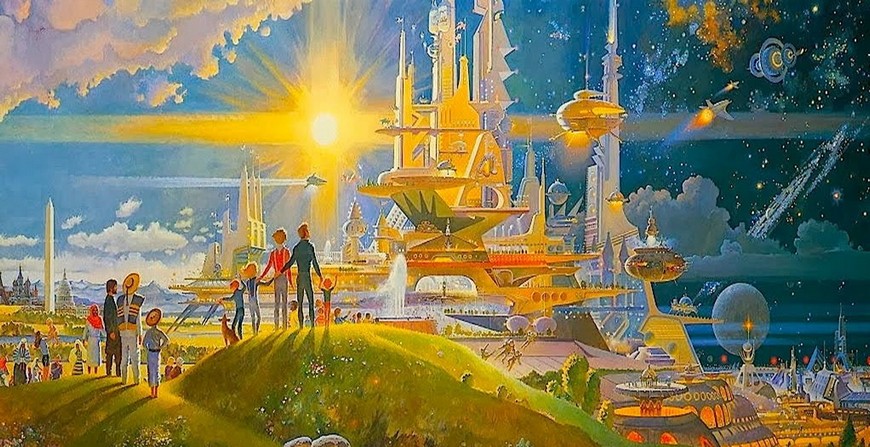
A space without wars. Where people, seeing reality as it is, will form a united people, living in a single state, with its social structure and laws based on a shared worldview. A space where moral principles, knowledge, development, and justice will be honoured — not in words, but in practice. A space where humanity will explore both its planet and the cosmos — not as greedy predators bringing destruction and ever ready to tear each other apart in competition for resources, but as inquisitive and responsible explorers, creatively applying their knowledge for their own benefit and for the benefit of the Universe. A space where people can trust one another, without fear of deceit, betrayal, or a knife in the back; where egoism and a consumerist mindset will be sources of shame rather than aspiration. A space built for humanity, for life filled with more joy than sorrow, for human development, improvement, and creative activity. And humanity itself will exist for people, for the world, and for the Universe — as those who can make everything around them better.
This is how we see the future in the space of the Teaching. Naturally, there will still be challenges — after all, this is not an ideal paradise, but the real world, where people remain people. And challenges — not just absolute evil, but something that stimulates progress. By overcoming them, we grow stronger, wiser, and more inventive. The key is to ensure that difficulties do not spiral into overwhelming disasters and suffering that make life unbearable. We will do everything in our power to prevent that in our world. So that the people of future generations, looking back at all of history — including our present — can rightfully say that their world is a good one.
Such is the future we are confident in and invite all to be a part of. It is a future without an apocalypse, without wars that annihilate nations and states, without greedy corporations buying and selling everything and exploiting those dependent on them, without dictatorships controlling every step, word, and thought of their subjects, without the enmity of nations, ideologies, and classes, and without so much else that kills, oppresses, and even turns people into little more than beasts. We fear none of this. The future in the world of the Teaching is one where people can truly live as human beings — without fear of being punished for it. We see what the world is today — but we reject pessimism. Because in the end, everything will be alright.
You may ask, do I guarantee that everything will be exactly as I say? My answer: no, I do not guarantee it. How could anyone guarantee such things? I simply know that it will be so. Not as a hope, a feeling, or a hypothesis — but as a certainty. That is what it means to be a prophet. If anyone chooses to take this as a guarantee — so be it.
© Atarkhat, 2023