
Destiny According to the Teaching

Man has always, throughout all times, strived to know himself. Moreover, it was not so much the individual who sought to know himself as a personality, but rather it was the human being who sought to know himself as a human. To understand what place he occupies in the world, and what his purpose is. This has always been more important than asking questions about oneself as an individual, and here’s why. On one hand, the social function of a specific person was defined quite clearly — according to their class and status. On the other hand, if it is clear what the purpose of man is in general, then your personal purpose is also clear. It consists in exactly the same thing. The only difference may lie in the way of its execution. For example, if a person is created to serve God, then a clergyman serves him in his own way, a nobleman in his own way, and a peasant in his own way. The main thing is to understand the purpose of man. Finding your personal path within the framework of this purpose — that is the secondary task.
In essence, the whole striving to know the world, all the attempts to build a clear picture of its structure, were driven by a more or less conscious desire to clarify one’s place in it. Moreover, this impulse was very practical. Life has never been easy, and so people were primarily interested in what could be practically applied in real life. Yes, something abstract was also interesting — but mostly as an entertainment, something captivating. To be interested in the world for the sake of knowledge itself, one needed a philosophical or scientific mind, and also time and resources. Very few could boast of all these at once. And if we talk about practicality, what could be more practical than an answer to the question of why a person was created? If you know the answer, then you already have a general idea of how you should live. So, this is not a frivolous question. It is a question of what you are and what you should do.
In recent centuries, and especially in the last century, the focus on the individual has become so pronounced that the individual has overshadowed the human. Everyone seeks their personal purpose, forgetting that it can only be defined and have meaning in the context of the world and a person’s place in the world as a phenomenon. It is impossible to chart a meaningful course in emptiness or chaos, without a coordinate system, and without localising yourself within that system. The old, tried-and-true scheme still applies here: if you know the purpose of man, then it becomes possible to determine your personal path and the meaning of your own life. This scheme is not just old: it is eternal. Because this is how it works, and no other way. And it will never work any other way. Because man is not by himself. He appeared as a result of evolution, took a specific niche in Nature, and performs a very specific function. He is an important part of the mechanism of the Universe. And this part is needed only if it performs its function well. Otherwise, there is no meaning to its existence.
Thus, the question of the purpose of man is a question of his very existence. Purpose is what gives him the right to exist. Otherwise, he simply isn’t needed. Don’t think that you exist solely because you are so unique and remarkable by yourself. No. You exist because you can do something that the world, Nature, and the Universe need. And you are unique because this is supposed to help you do the right thing. You are not separate from the world. You are integrated into it, you are a part of it, you live its life. And it is essential to understand how important this is.
And it is important. Of primary importance. Because the purpose determines the goal of life. A clear goal enables the development of methods to achieve it. And it allows one to understand their own capabilities — because if Nature has set a specific goal for you, it has also embedded the necessary resource for its achievement within you. In other words, if you know what you must do, you know what you can do. This is already a lot for understanding yourself. Next, the methods to achieve the goal imply certain actions — that is, deeds. This is already behaviour, a way of interacting with people, society, and the world. This is how the psychological map of a personality is formed and how a lifestyle is developed. How you live — including domestic life, child-rearing, profession, communication, socio-political views, and so on — depends on what you are striving for. What you strive for is what you consider the meaning of your life and what you are ready to dedicate your life to.
Everything mentioned above is logical, and therefore simple and clear. A person has a purpose, in accordance with which he sets his life goal, in accordance with which his way of life is formed. I will summarise what follows from all this as follows: you are what you strive for, and your life is the realisation of this in reality.
This concerns the individual person. As for humanity, it is the same, but on a larger scale. The goals that humanity sets for itself, the methods of achieving them, and the very mode of existence, including all the surrounding circumstances — all of this must be formed based on its, humanity’s, purpose. Our entire civilisation must naturally be built around the purpose of man, as around a core, and evolve in accordance with the principles and methods of fulfilling that purpose. Then the development will be successful, and existence will be prosperous — because humanity will not suffer from a destructive internal conflict: the mismatch between what it does and why it exists.
This is a topic for another conversation. For now, I will say briefly and simply: the understanding of purpose forms the entire life of both the individual person and humanity as a whole. How we understand our purpose determines our goals, and we are defined by them.
Therefore, understanding your purpose is so important. It is one of the most important things. And in a certain sense, it is the most important. Because it determines what you should be. The formation of personality — should I need to explain further how immensely significant it is? This encompasses everything related to the person and their personality. And even more. Because a person shapes the space around him, the world, society, the surrounding reality. Purpose moulds the person, and the person moulds everything else. Purpose is the wondrous force that creates and transforms our world.
More precisely, this is how it should be. Because although it exists, it still needs to be discovered, realised, and accepted as a life guide. Actually, I began this conversation with this: that people have always sought the purpose of man, trying to determine what it consists of. This is not something abstract, but a matter of utmost necessity. Almost all religions and philosophies are nothing more than attempts to provide an answer to the question of purpose. They offer versions of the world’s picture, schemes of its structure — that is, the very system of coordinates in which one can only localise themselves. As to how successful the search has been, we won’t debate that now; let’s just say that judging by the results we see, both in history and in today’s world, it has not been very successful. Let us turn to what the Teaching says on this matter.
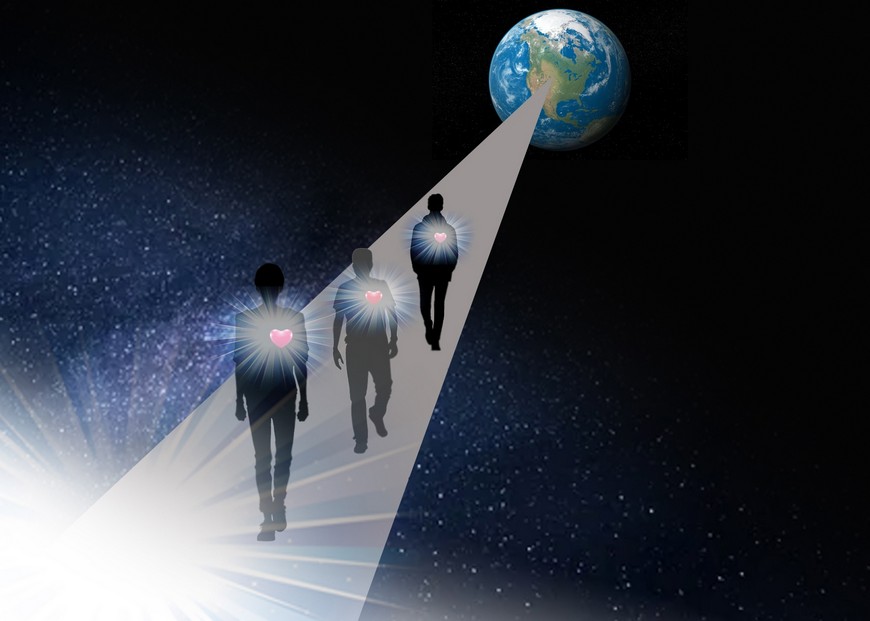
According to the Teaching, the Universe is the Creator, transformed for the purposes of self-knowledge and self-improvement. The process of evolution within the Universe began at the moment of transformation, and its direction is aimed at the appearance within it of those who are called “the sentient beings” — intelligent entities capable of purposefully knowing the world and themselves, comprehending the acquired information, giving a moral evaluation to what happens, and making choices through free will. The Universe contains many intelligent races (that is, species of sentient beings), and humanity is one of them. Each sentient being carries within itself a particle of the Spirit — that which can be called the soul of the Creator. The Spirit contains the personality of the Creator, his ability to think, his qualities. And also his imperfections — that is, those flaws he could not work through and correct in himself before his transformation into the Universe. The goal of the transformation was to correct these flaws. This must happen through the sentient beings, who can know the Creator as if from the inside, in such details and nuances in which he had not had the chance to know himself before. In each sentient being, the reason and qualities of the Creator are manifested; one could say that the Creator thinks through the sentient beings, explores himself through them. Each sentient being is capable, based on what it has learned, of giving everything a moral evaluation and making a moral choice between good and evil. When the choice is right, the particle of Spirit that the being carries within itself becomes more perfect. In this way, all sentient beings collectively perfect the soul of the Creator, which is distributed among them in the form of particles of Spirit. By fighting their own vices and shortcomings, improving themselves intellectually and morally, they thereby correct the imperfections of the Creator.
This is the purpose of the sentient beings. All of them, without exception. They are the ones who carry out the Creator’s evolution at this stage. They are the ones, thanks to whose efforts and labour, the Creator will one day be able to be reborn into a more evolved, more perfect being. Thus, they are doing the most important work in the Universe. The work for which the Universe was created, the work for which evolution is taking place within it. As was already said, it is initially aimed at the appearance of sentient beings, from whom the Creator’s further fate depends.
People are also sentient, and therefore the purpose of human beings is the same as the purpose of all sentient beings. On a short time scale, that is, within one human life, this purpose is the knowledge of the world, the improvement of oneself (changing oneself for the better), and the improvement of the world. On a long time scale, it is the improvement of the Creator, thanks to which he can be reborn and continue to live.
The particular intertwines with the universal. Your personal task, which you carry out in your life, is part of the global task that encompasses everything and everyone; what you do is part of the work of cosmic scale and universal importance. You yourself are a part of the Creator, your life is part of his life, your improvement is his improvement, his life is your life, his future is your future. What you are doing right now is important for the Creator in Eternity. Because you are doing the most important thing in the world. In the world and in the Universe.
In practice, this means, first and foremost, knowledge of the world, knowledge of reality. Because you need to make a choice — but how can you make it if you don’t know what you are choosing between, why you can choose, and for what reason you are doing this? So, knowledge, and then a moral choice. That is how you improve yourself, and in fact, you improve the Creator. Overcoming your flaws, correcting your shortcomings — in fact, you are correcting his internal shortcomings. By better understanding the world and becoming better yourself, you gain the ability and opportunity to make the world better. That is, through knowledge, moral choice, and useful creative action, a person improves themselves, improves the world around them, and improves the Creator (the Universe). This is their purpose, explained as simply as possible.
It is especially important to understand the following connection: you are doing the most important thing in the Universe, but you are doing it through ordinary tasks available to you in your current life. That is, you are not required to be omnipotent and change the fate of galaxies with a wave of your hand. You are doing the great task through small tasks. You refrained from an improper act — and the Creator became more perfect. You did something right and useful — and the world became better, and the Creator became more perfect again. The miracle of what is happening is that a small person, through small deeds, shapes the fate of the Universe. And that means that the small person is, in reality, nothing but an embodiment of the Creator.
People, like other sentient beings, come into the world to fulfill their purpose. This is their evolutionary function. For this, they are born as rational beings. The task of each newly appeared civilisation is, through the study of the world and its own development, to come to an understanding of and fulfillment of its purpose. That is, to learn to do what the civilisation was created for. The evolutionary goal of a civilisation and the goal of an individual as its particle are no different, except in scale. In other words, when individuals strive to fulfill their purpose, the goal of the civilisation itself becomes the same; and when the goal of civilisation is such, individuals are raised in the same way.
This general principle works in the case of humanity in the same way. It initially strove for knowledge, obeying the instinct, that inner imperative laid in it by evolution itself. It appeared to know and improve, it is “cut” for this, and it is drawn to this, and has always been, even without realising it. The essence of what is happening is to know the world to the degree sufficient to understand the place and function of humans in it. That is, to understand the purpose. Then — the recognition of this purpose by the person and the building of their life in accordance with it. The life of an individual and the life of humanity as a rational species, as a civilisation.
If approached properly, purpose determines everything. I mean — when it is known and realised. Its fulfillment is the goal of life. The entire life is built around this conscious goal. This is natural and normal. For example, a guy’s goal is to become a soldier and serve his country. He strives for this from childhood. This aspiration shapes his interests and hobbies, partly forms his circle of communication and friends. Then he enters a military school. Then he serves, which will now become his way of life. This is how his psychology is formed, his attitude towards life, his principles. This is how his family is formed — because his wife will have to be a soldier’s wife, with all the consequences, and his children will see the military life and be influenced by it. Military service determines where he will live, what he will do, and possibly when and how he will die. Service for him is not even just a way of life, but life itself. This is what he has become, and this is what he does. This is what he brings to the world. And so it is with every goal. If it is a serious goal, if there is serious work behind it, it defines the whole life of a person.
Likewise, conscious purpose defines the life of the one who has realised it. Their goal is to help the improvement of the Creator so that the Creator can live. What is needed for this, as mentioned earlier: knowledge, work on oneself, the ability to make the right moral choices, labor for the benefit of the world. These are the general tasks. The canvas upon which everything else must be embroidered. Because to solve the general tasks, specific ways are needed. Aspirations and intentions must take a specific form. There are many ways and options for implementing them in life, and each person chooses the one that suits them best, according to their desires and abilities. In the Teaching, this is usually compared to a huge stream, in which each person is a unique current. All currents are unique, none repeats the other — but at the same time, all of them flow in the same direction, in one common stream.
Thus, with purpose. It is one for all, and the goal here is common. However, everyone goes to it in their own way. Occupation, lifestyle, hobbies, anything — everything can be arranged in such a way that it does not hinder the purpose, but on the contrary, will help it, work towards it. Knowledge can always be gained; wherever you look — there will be something to learn. You can constantly work on yourself; everything that happens to you is material for such work. Life provides an abundance of situations for moral choices, more or less significant. There are so many ways to make the world better, to improve the world, that you couldn’t exhaust them in a thousand lives. In a word, in terms of fulfilling your purpose, the possibilities are limitless. Everyone can find an option they like.
This is to say that one purpose for all does not mean something identical and boring. It is like literature. The language can be the same, and the way of recording texts is also the same — but the variations of what is written can be endless. Genres, styles, directions, forms, themes, meanings, volumes, and so on, and so forth. From tragedy to comedy, from aphorism to multi-volume scientific research, from a poetic epitaph to a heroic poem, from a story about love to political satire… You can’t list them all. Just take and create — as you want and can. The same goes for purpose. Bring it to life however you want and can. The possibilities are endless, the field for their realisation is the whole world, all of life, all of you.
The main thing is to remember how important what you are doing is. This is the most important thing in the Universe. To do it properly, it is worth putting in the effort. You are here for this purpose, so don’t be afraid to spend time on it. Even all your time, however much you have. Everything else important is merely particles of this most important work, without which the rest has no meaning. Yes, there are many important tasks. But you need to make sure they harmoniously weave into the most important task. That they are its particles, its manifestations, its facets. That by doing any of them, you are doing the most important task. This is how a person lives, following their purpose.
This is how it happens. First, we search for purpose, as the most necessary thing in life, as something that gives life meaning. Having found it, we learn to live in accordance with it. This means that with the successful completion of the search, difficulties do not end. Perhaps the most difficult part has just begun. We are like builders looking for a place to build a house. Finally, with great difficulty, the place is found — and now the real work begins. And if it were possible to seriously envy oneself, I would envy. Participating in the greatest, most important task and knowing that no effort, no bit of your labor will be in vain — what more can you wish for to consider your life successful?
© Atarkhat, 2022