
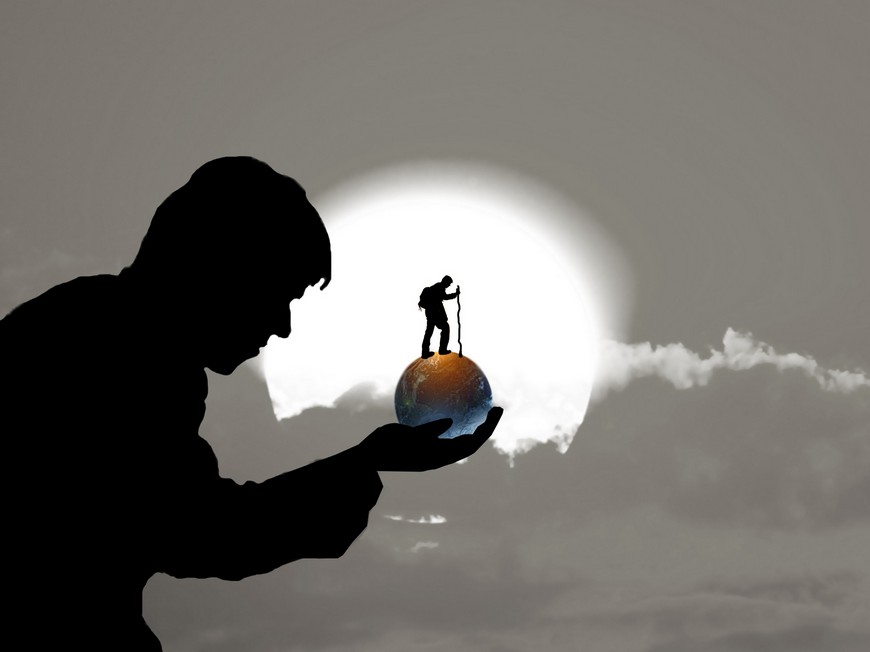
Freedom According to the Teaching

Freedom is such a vast and important topic, with so many significant aspects and nuances, that a thoughtful analysis could make up a full book, or even several. Therefore, I will touch upon only a few fundamentally important points. These are foundational in how freedom is understood in the Teaching. We are not talking about political freedoms and similar matters here. All of that is merely a derivative of the freedom that every person has in every moment of their life. That is, the interpretation of some initial condition, its manifestation in various circumstances. It is this condition that will be discussed.
It is impossible to argue that freedom is one of the greatest values. In this, the Teaching agrees with the commonly accepted point of view. However, even with such agreement, the approach still turns out to be different. Society tends to absolutise freedom. Many — and this number is growing over time — equate freedom with the complete absence of any restrictions. It is confused with unrestrained caprice and lawlessness. At the same time, the concept of “freedom” is strongly tied to physical freedom. “To deprive someone of freedom” means to imprison them or simply bind their hands and feet. In reality, such associations are very superficial. The true meaning of freedom is evolutionary in nature, and it is not about whether someone is tied up or not.
So, let’s examine the most important aspects of freedom as it truly is.
First. The concept of “freedom” can only very slightly relate to physical freedom. This is because the human body is extremely limited in its abilities. Of course, one can talk about freedom within certain limits; but these limits are so narrow that the conversation becomes almost meaningless. It’s hardly freedom when you just physically can’t do very much. Essentially, you cannot do much more than what you can. You cannot run faster than the capabilities of your body allow. You cannot inhale more than the volume of your lungs; and at the same time, you cannot stop breathing. You cannot jump higher than your muscles and gravity allow. You cannot fly; well, unless you’re in an airplane — but even then, you have to comply with a number of additional conditions. You cannot be in any place you want; and even where you might have been able to, you might not get there due to illness or lack of money. You cannot stop aging. You cannot take something in your hand if you don’t have a hand. You cannot carve a statue from marble if you lack talent, material, or tools. You cannot… You cannot… You cannot… Purely physical impossibilities are supplemented by a huge number of impossibilities determined by rules. For example, you cannot (that is, physically you can, but you shouldn’t) cross the road when the light is red, or enter someone else’s land if the owners don’t permit it.
When comparing what we cannot do to what we are capable of doing, the balance will definitely not be in favor of the latter. In fact, physically we can very little. Our physical freedom is very and very limited by definition. It depends on many factors that are beyond our control — which means, in reality, we can hardly manage it. Certainly, it matters; but it cannot be placed at the forefront. This means that when the Teaching speaks of freedom in its worldview, physical freedom is mentioned last.
Second. Absolute freedom, which excludes any restrictions and is seen by many as an ideal and something to strive for, is actually impossible. Moreover, it is unnatural because it contradicts the principles of Nature. Everything that exists does so because it is part of a system. A complex system of the Universe, which includes many other systems. And a system is an order, where everything is in its place and interacts in the correct way. Arbitrary changes in the system lead to disruptions in its functioning and destruction. What would happen if your liver decided to move to where your heart is? Or if the nuclear processes in the sun just changed? Or if the laws of gravity stopped working across the Universe?
Man is also a part of this world system. He occupies his place in it — and it is not the place he chose for himself, but the one destined for him by evolution. It is determined by his evolutionary origin, structure, abilities, and possibilities, etc. And most importantly — by his role in the further evolution of his world and the Universe. That is, his purpose. This means that absolute freedom is not only impossible for him but also unnecessary. And if you think about what exactly people mean by “absolute freedom” or “complete freedom,” it becomes clear that most often it refers to the ability to freely carry out one’s desires. That is, the meaning of the great struggle for human freedom, for expanding its boundaries, turns out to be the most primitive one imaginable: simply to have no one interfere with you fulfilling your wants. This is not even the animal level, but below it. After all, animals occupy their place in the system of Nature, and what they want turns out to be exactly what Nature needs. Man, however, often desires what he should not want, what is harmful to Nature, to the world, and to himself. Freedom is freedom — but it does not justify evil. That is, no action is right and good simply because someone had the freedom to carry it out. And when we act wrongly, poorly, we cease to be an organic part of Nature, as if falling out of its system. And we are very much needed in it. We (humans and sentient beings in general) play a key role in the evolution.
Therefore, our task is not to gain as much freedom as possible, but to understand our role, our purpose, and learn to follow it. That is, to essentially learn to be ourselves. However, “being yourself,” contrary to popular belief, does not mean having the opportunity to freely carry out all your desires. Quite the opposite: the ability to refrain from fulfilling your desires constitutes a huge part of true freedom. But more on that below.
Third. The main manifestation of freedom available to us is the freedom of choice. This is its essence. Because this is what has evolutionary significance. The role of the sentient beings is to perfect the Spirit. For this, we are given — as the fruit of the same evolution — the ability to think and understand. We learn about the world, the Universe, its laws, and thereby learn what is good and what is evil. That is, we learn to understand what is good for the system in which everything exists and what is bad and destructive. And if we understand, then choices present themselves to us, one after another, constantly and inevitably. We choose between good (which may be difficult or dangerous for us personally) and evil (which may be pleasant or beneficial for us personally). By choosing good, we perfect ourselves morally, and thus spiritually. And as the Spirit of a specific person is perfected, the Spirit of the Universe also improves — that is, the soul of the Creator. And this determines the future of the Universe and all its inhabitants.
This is how it works. And the key condition here is the freedom to choose between one and the other. Only in this way can the Spirit be perfected. Therefore, true freedom is not external but internal. Not the freedom of the body, but the freedom of the will. In a certain sense, we live in order to implement it. Our work in the Universe is to perfect the Spirit; and this is possible only through the freedom of choice. And so it turns out that the meaning of our lives is inextricably linked to it.
And it is always there. Because the choice is always there. In fact, a person chooses only by themselves; no one can force them to make a particular choice. Some may argue with this, pointing out that one can exert pressure on a person, even torture them, and thus deprive them of free choice. But I answer: this is not the case. They always have a choice — to obey or not, to endure or to give in, to die or to buy life at the cost of agreeing to what they are forced to do. Yes, the choice is, to put it mildly, not the most pleasant — but it is still a choice. If someone threatens death, they choose between life and their principles, deciding what is more valuable to them. They choose themselves. Because even though their body is under threat, no one has power over their will, except for them. And there were people, many of them, who chose principles in such a situation. They died, but they remained free. They were free for real, and not with that paltry bodily freedom, which can only be called freedom with a great stretch and which is so easy to cross out. This is what matters: a person can be forced, but they cannot be made to choose. One only surrenders if they allow themselves to. Why? Because, in fact, we are much stronger than we think. After all, a person, like any sentient being, is the driving force of evolution. And this is tied to the freedom of choice. It would be strange if, with such a purpose, such possibilities, and such responsibility, we were not given enough strength to carry it out. Our strength, through unity with the Universe, is almost inexhaustible. The problem is that some don’t know this, others don’t believe in their strength, and others don’t want to use it, preferring to seek easy paths. Well, in the end, everyone is free to choose, and they decide whether or not to use their strength.
A few more words about physical unfreedom. For example, let’s take a slave. It may seem that they have neither freedom nor choice. But no. There is a choice. Even several options. They can submit. They can commit suicide. They can try to escape. They can rebel and take up arms. They can simply refuse to obey — and whatever happens, happens. In short, there is always a choice. Even if you are sitting in a dungeon without windows and your hands and feet are shackled. The physical conditions do not matter. As long as you have at least two options to choose from, you are a free person. And as already mentioned, there are always options.
This aspect of freedom — the freedom of choice, the freedom of will — is the most important. It is the foundation of this concept. All other forms and manifestations of freedom are just its derivatives. They are particulars, while it has evolutionary significance. We, humans, alongside other sentient beings, are its bearers and executors. And it is especially important to understand the following: a person cannot have their freedom taken away. True freedom, that is. Not the ephemeral freedom of the body. If you are thrown into a dungeon, it is the problem of your body, not yours. You remain free. Because no one has power over your will, except you.
Fourth. An important manifestation of freedom is the right to limit oneself in something. No one can force you to do this. The ability to set one’s own limits, which cannot be overstepped, is the realisation of freedom in practice. After all, absolute freedom is impossible. We are limited in any case. And if we exclude what is physically beyond our control, we decide for ourselves what is acceptable and what is not.
A person obeys laws, customs, traditions, and rules. But they obey these because they believe it is the right thing to do, or that it is better for them. And those who don’t believe that, violate these rules. They may be shown unpleasant alternatives — violating the law will lead to prison, breaking a custom will cause condemnation, and so on — but no one can force them to comply. Here we are dealing with a principle that can be formulated as follows: freedom is not the absence of restrictions, but the ability to set your own limits. And this opportunity is always available. It is often realised almost automatically. In the sense that we usually do not consciously realise our choices and decisions. The patterns laid in our psyche by upbringing, habits, and societal demands, which we are a part of, are carried out. We make decisions without emphasising them for ourselves. We simply agree with what we have been taught, and with what is accepted in our surroundings. This is also a choice — but one that is unnoticed by the chooser, who perceives it as, “It couldn’t be any other way. Or maybe it could, but not for me.” Only when something significantly changes for a person do they start to reconsider the realities of their life and face the choice between what is and what could be. Now, it is a conscious choice. And if earlier the boundaries were set “by default”, and they just reacted to them like a command to “Stop!”, now they evaluate them. They ask themselves questions like “Where did they come from?”, “What is their meaning?”, “What would it be like without them?”, “Do I agree with them?”. And if they find them wrong or meaningless, they cancel them for themselves.
And they establish or simply accept new ones. Because life cannot be lived without boundaries that you do not cross. Any worldview or life stance implies that there is something you cannot do, because you should not. There is a line you will not cross. More precisely, a set of such lines related to different aspects of life. This is normal, it should be like this. Those who do not have such boundaries are likely not entirely normal. Such people are called “boundaryless” and “reckless”. So, each person sets their own boundaries. However, it cannot be said that they invent them. Usually, they choose them from already known options, justifying them for themselves. For example, should I lie or not? Most people lie; yet everyone knows that lying is bad. What are my personal reasons for not lying? Why should I not do this? And so on. A person sets boundaries for themselves, limiting their freedom. Or they accept restrictions as a package, adopting a religion or another worldview in which they are applied. In any case, the important thing is that, firstly, life cannot be lived with total permissiveness (it simply will not work), and secondly, we set our own limits — either one by one or by adopting a system. This is a choice — and it is always free. Someone can offer you something, but they cannot force you. This is the essence: we manifest the freedom of choice by limiting our freedom of action.
This is one of the most important aspects of freedom. It includes self-limitation. And those who fundamentally do not want to limit themselves in anything, fearing they will lose freedom, have already lost it — for they deprive themselves of the ability to make a choice in favor of limitation. They cannot go that way, and in doing so, they are not free.
Fifth. There is an aspect of freedom that does not manifest in direct action. This is the freedom that comes from unity. The Universe is a unified organism, and thus everything in it is one. Each particle of it is, in a certain sense, each other particle. And even more so than for matter, this is true for the Spirit.
The Spirit is simultaneously both one and distributed among the material particles of the Universe. One can say that each of us has our own particle of Spirit, but at the same time, these particles make up the collective soul of the Universe, the soul of the Creator. The human soul is individual; but its foundation, the particle of Spirit, is one with the Spirit of other people, and of all sentient beings, and indeed all particles of the Universe. Each particle of Spirit is simultaneously every other particle of Spirit, and all of them together. That is, in essence, each person, through their particle of Spirit, contains the entire Universe within themselves. Their inner space stretches to its boundaries. And within these boundaries, they are free. Externally, they are just a weak and extremely limited physical organism; internally, however, they are the Universe itself. Each of us is like a thimble that contains the ocean. And in this ocean, we can travel freely.
To illustrate this, I will cite an excerpt from the mitevma “The Fathers”. The ruler of the Seven Lands wants the Teacher Ilan to stay in the palace and talk with him, but he refuses. Attempts to force him lead nowhere. Then we read: “The Ruler replied, “It is not easy for me to ask you. You are not afraid of torture or death, and I cannot force you; but I don’t want to let you go. Buy yourself freedom not to stay here for years until death, talk to me for a few days, and I will let you go. Do not be afraid of deceit, for the Ruler of many lands will not fall to despicable deceit”. Ilan said, “I am not afraid of deceit because I have already known you good enough. I need freedom; but it has no price, and I cannot buy it from you. And the freedom that I have within is enough for me to live, after all, there are infinite spaces within me. I will stay here as you said.” Then the Ruler was sitting and was thinking in silence for a long time. Then he said, “If so, then I let you go. I am cruel when have to; but only a madman, a coward, or a fool is cruel without a reason.” (The Fathers III, 34-44). Ilan’s body might have remained imprisoned — but this had no decisive significance for him. He knew that “within him were the heavens”, and he felt them. He was free inside, even though he was a prisoner. He could continue living a full inner life. Therefore, he could not be intimidated or forced, even with threats of deprivation of freedom. Inner freedom cannot be taken away. The ruler himself did not experience this, but he saw before him a person who felt and lived this way — and understood that he was powerless to oppose him.
Every person is free inside, for they contain not only the whole world and the heavens but the entire Universe. This is already as a given. However, it is difficult to make use of the freedom you are unaware of. But if you know it, if you feel it and understand it, then you are truly free, and no one can defeat you, make you a prisoner, or force you to do anything. Who can imprison the Universe in a dungeon?
These are the main aspects of freedom. They are like roots from which everything else related to it grows. Of course, this is only a rough sketch, in the broadest terms. However, what has been said is sufficient to understand the approach of the Teaching to such an important concept as freedom. Important not only for humans but for the Universe, for its evolution and life. The importance of freedom cannot be overstated. But it must be understood correctly. Otherwise, the greatest value can turn into the greatest illusion and the greatest disappointment.
I will finish with one more quote from the pandect: “Freedom is not lost, but only found — this is its great quality.” (Eosfor I, 13).
© Atarkhat, 2020